Offshore Crypto Licenses: 2026 Guide
Offshore crypto licenses provide a legal framework to operate a global cryptocurrency business with advantages that include regulatory clarity and tax benefits. Navigating the growing landscape of licensing options requires clear guidance and strategic decision-making.
At We Form Online, our guide helps entrepreneurs understand the key regulatory requirements, benefits, and popular jurisdictions for offshore crypto licenses. Whether you seek flexibility or European market access, this overview clarifies your path.
Thinking about forming your company in a top crypto jurisdiction? We Form Online makes it simple — our team handles everything from name registration to compliance setup.
Choose Your Jurisdiction

What Exactly Are Offshore Crypto Licenses and What Are The Benefits of Obtaining an Offshore Crypto License?
An offshore crypto license is a formal authorization from a foreign government that permits a company to conduct specified crypto-related activities. These can include operating a cryptocurrency exchange, providing digital wallet services, launching new tokens, or engaging in DeFi protocols. The primary goal is to create a compliant operational base outside of your primary country of residence.
The core benefits that attract entrepreneurs include:
- Regulatory Clarity: Operate within a defined legal framework, reducing ambiguity and business risk.
- Enhanced Credibility: A license signals to customers, investors, and banking partners that your business adheres to established standards.
- Global Banking Access: Licensed entities often find it easier to open corporate bank accounts and secure payment processing solutions.
- Tax Optimization: Many offshore jurisdictions offer highly favorable tax environments, including zero or low corporate tax rates.
Popular Jurisdictions for Offshore Crypto Licenses
While many jurisdictions offer some form of crypto authorization, the quality and reputation of the license vary dramatically. At We Form Online, we focus on premier jurisdictions that offer a blend of robust regulation, international credibility, and a pro-business environment. The United Arab Emirates (UAE) is a top choice for our clients.
United Arab Emirates (UAE)
The UAE has rapidly emerged as a global crypto hub, with free zones like the Dubai Multi Commodities Centre (DMCC) and the Dubai World Trade Centre (DWTC) Authority offering dedicated crypto licensing regimes. The country’s regulators have embraced digital assets, creating a stable and innovative environment. While places like Costa Rica were considered in the past, we’ve found that the UAE’s clear regulations and strong banking infrastructure provide a more stable foundation for our clients.
- Best for: Businesses seeking a prestigious regulatory environment, access to deep capital markets, and a 0% corporate tax rate on qualifying income.
- First-Hand Insight: Based on our experience, securing a UAE crypto authorization requires a comprehensive business plan and clear proof of substance. For a recent client setting up in a Dubai free zone, We Form Online guided them through the process, which included submitting a required initial share capital deposit of AED 50,000. Navigating the specific requirements of different free zone authorities is a common hurdle we help clients overcome, as each has its own nuances.
Choosing the right jurisdiction is complex, but you don’t have to do it alone. Our team at We Form Online specializes in structuring crypto businesses in premier locations like the UAE. Let us help you find the perfect fit.
Comparative Analysis: Offshore vs. MiCa Crypto Licenses
The introduction of the Markets in Crypto-Assets (MiCA) regulation has created a harmonized framework across all 27 EU member states. This presents a significant choice for crypto entrepreneurs: pursue a flexible offshore license or a comprehensive MiCA license?
| Feature | Offshore Crypto License (e.g., UAE) | MiCA Crypto License (EU-wide) |
|---|---|---|
| Jurisdictional Scope | Specific to the issuing country (e.g., UAE). | Passportable across all 27 EU member states. |
| Regulatory Oversight | Managed by a single national or free zone authority. | Harmonized and strict, overseen by national authorities and ESMA. |
| Compliance Burden | Moderate, focused on AML/KYC and business viability. | High, with extensive requirements for governance, and consumer protection. |
| Tax Environment | Often highly favorable (e.g., 0% corporate tax in UAE free zones). | Subject to the domestic tax laws of the EU member state. |
| Time to Market | Generally faster; can be as quick as 2-4 months. | Longer, often 6-12 months due to detailed review processes. |
Regulatory Requirements for Offshore Crypto Licenses
Regardless of the jurisdiction, every applicant must meet a core set of regulatory requirements designed to ensure transparency and prevent illicit activities. Our team manages this entire process, but it’s helpful to understand what’s involved:
- Corporate Entity Formation: You must first establish a legal company in the jurisdiction.
- Detailed Business Plan: A comprehensive document outlining your business model, services, target market, financial projections, and governance structure.
- AML/KYC Policies: Robust Anti-Money Laundering (AML) and Know Your Customer (KYC) procedures are non-negotiable. These must comply with international standards.
- Proof of Substance: Regulators need to see that the company has a genuine presence, which may include a local office or resident directors.
- Fit and Proper Test: All shareholders, directors, and key personnel must undergo background checks to prove they have a clean record and relevant experience.
- Minimum Capital: Most jurisdictions require a minimum amount of share capital to be deposited in a local bank account.
These standards are heavily influenced by global bodies. As of January 2025, the EU’s comprehensive Markets in Crypto-Assets (MiCA) Regulation is fully enforced, setting a new global benchmark for compliance.
Typical Pitfalls in the Licensing Process (And How to Avoid Them)
Based on our first-hand experience helping hundreds of clients, here are common mistakes that can delay or derail an application:
- Incomplete Documentation: Submitting a business plan that lacks detail or failing to provide complete due diligence on directors is the #1 reason for rejection.
- Underestimating Capital Requirements: Beyond the minimum share capital, you must account for operational costs, professional fees, and regulatory fees.
- Ignoring Substance Requirements: Simply registering a company isn’t enough. Regulators are cracking down on “shell companies” with no real local presence.
- Poorly Defined AML/KYC Procedures: Generic, template-based AML policies are a major red flag for regulators. They must be tailored to your specific business risks. We’ve seen applications get returned with requests for more specific transaction monitoring protocols.
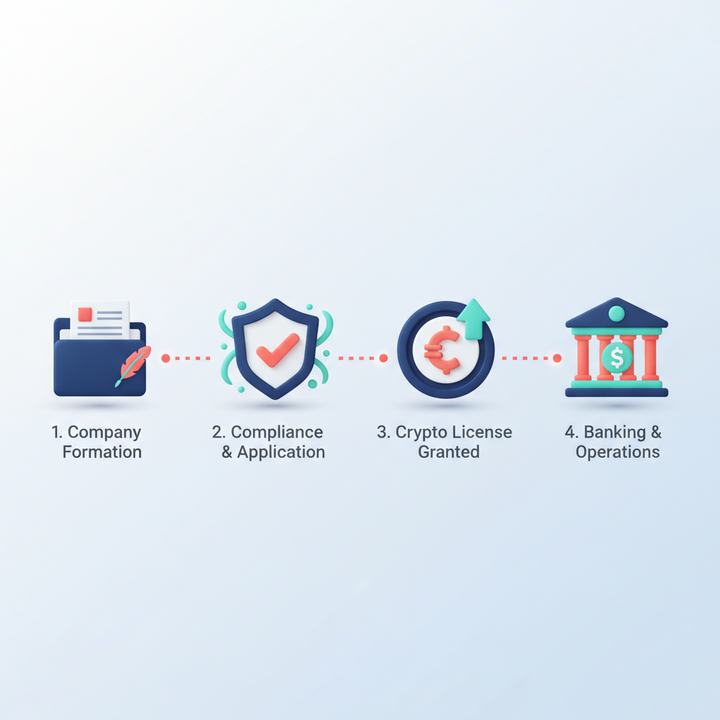
Our Step-by-Step Crypto Licensing Process
At We Form Online, we’ve refined the licensing journey into a clear, manageable process:
- Strategy & Jurisdiction Selection: We start with a deep dive into your business model to recommend the optimal jurisdiction.
- Company Incorporation: We handle the complete formation of your new corporate entity.
- Documentation & Policy Crafting: Our team prepares the business plan, AML/KYC manuals, and all other required application documents.
- Application Submission & Liaison: We submit the full application package and act as your primary point of contact with the regulators.
- Bank Account Opening: Post-approval, we assist in opening a corporate bank account to hold your share capital and manage operations.
- Ongoing Compliance: We provide continued support to ensure you remain in good standing with all regulatory requirements.
Glossary of Key Terms
- AML (Anti-Money Laundering): A set of laws and regulations designed to prevent the generation of income through illegal acts.
- CASP (Crypto-Asset Service Provider): The legal term under MiCA for any entity providing crypto-related services in the EU.
- FIU (Financial Intelligence Unit): A government agency responsible for receiving and analyzing financial information to combat money laundering and terrorist financing.
- KYC (Know Your Customer): The process of a business identifying and verifying the identity of its clients.
- MiCA (Markets in Crypto-Assets): The landmark EU regulation creating a unified legal framework for crypto-assets.
- Substance: The requirement for a company to have a genuine physical presence and conduct real economic activities in its jurisdiction of incorporation.
Tax Implications of Owning an Offshore Crypto License
One of the key draws of an offshore crypto license is the potential for significant tax advantages. Jurisdictions like the UAE offer a 0% corporate tax rate for businesses operating within their free zones. However, your company’s ultimate tax liability is more complex and depends on factors like Controlled Foreign Corporation (CFC) rules in your home country and your personal tax residency. We always advise consulting with a qualified tax professional to understand the full picture.
Frequently Asked Questions (FAQs)
1. How long does it take to get an offshore crypto license?
Timelines vary by jurisdiction. A UAE license can often be secured in 2-4 months, depending on the complexity and completeness of the application. More intricate applications can take longer.
2. What is the main benefit of an offshore license over a MiCA license?
The primary benefits are typically lower costs, faster time-to-market, and a more favorable tax environment. However, this comes at the cost of not having access to the unified EU market.
3. Do I need to physically relocate to obtain a license?
Not always, but most jurisdictions require some form of local substance. This can often be achieved by appointing local directors or using a registered office address, both of which our team at We Form Online can arrange.
4. Is a MiCA license valid in every EU country?
Yes. Once a Crypto-Asset Service Provider (CASP) is licensed in one EU member state, it can “passport” its services across all other 26 member states with minimal additional authorization.
5. Can We Form Online help with compliance after the license is issued?
Absolutely. We offer ongoing compliance, accounting, and corporate secretarial services to ensure your licensed entity remains in good standing with all local and international regulations.
6. What are the tax implications of owning an offshore crypto license?
While jurisdictions like the UAE offer 0% corporate tax, you must still consider your personal tax residency and your home country’s rules on foreign-owned corporations (e.g., CFC rules). We always recommend consulting with a tax advisor for your specific situation.
Take the Next Step with We Form Online
Securing a crypto license is a decisive step toward building a sustainable and credible global business. Whether the flexibility of an offshore jurisdiction like the UAE or the market access of an EU MiCA license is right for you, our expert team is here to manage the entire journey.
Ready to launch your regulated crypto business and unlock your global potential? Contact our specialists today for a personalized consultation and let We Form Online provide the clear path to your success.
Schedule a 15 minutes introduction call with our experts to meet your exact business needs
Schedule a Free Consultation Today