Tax Numbers Specific per Country
What tax identification numbers look like in the UK, the US and other popular jurisdictions, who gets them and why banks ask for them.
 6 min read
Most tax authorities use a tax identification number (TIN) to track the tax affairs of individuals and companies. The name, format and the way it is issued differ from country to country, which causes confusion for founders who live in one country and own a company in another.
This guide explains the main tax numbers in the UK and the US, how company tax numbers work in several other jurisdictions, and why banks and payment providers will ask for yours.
Why tax numbers matter for international business
Under the OECD Common Reporting Standard (CRS) and the US FATCA rules, financial institutions must identify where their account holders are tax resident and report certain information to tax authorities. That is why a bank, electronic money institution or payment provider will ask you, and your company, to complete a tax self-certification listing each country of tax residence and the matching TIN. Having the right numbers ready speeds up account opening. Our article on the difficulties of opening a bank account covers the other documents you will usually need.
UTR in the UK
The UK does not issue a single number called a "TIN". Instead, two numbers do the job for individuals, and companies receive their own references.
UK alternatives to a tax identification number
- Unique Taxpayer Reference (UTR): a 10-digit number issued by HMRC to individuals and organisations that need to file tax returns, for example the self-employed, company directors with untaxed income and landlords. It appears on tax returns and HMRC letters but is not printed on any identity document. HMRC explains how to find a lost UTR.
- National Insurance number (NINO): made up of two letters, six digits and a final letter A, B, C or D, for example QQ 12 34 56 C. It is used for National Insurance contributions and state benefits and is also accepted as a TIN for individuals in many contexts. A NINO is not proof of identity.
Both numbers are issued once and do not change.
Tax numbers for UK companies
- Company registration number (CRN): an 8-character number issued by Companies House when the company is incorporated. It identifies the company on the public register but is not a tax number.
- Company UTR: HMRC sends a 10-digit UTR to the registered office after incorporation. It is used for Corporation Tax.
- VAT registration number: issued if the company registers for VAT, written with the GB prefix and nine digits.
- Employer PAYE reference: issued when the company registers as an employer.
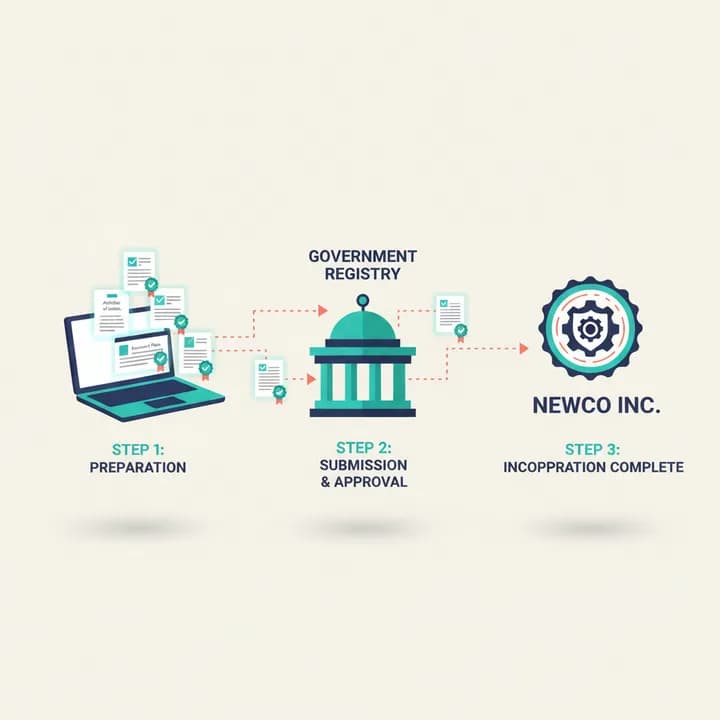
For the full incorporation process, read our guide to registering a company in the UK.
Does every UK resident get a UTR or NINO?
Not automatically. Most people who grow up in the UK are sent a NINO shortly before their 16th birthday. People who move to the UK apply for one when they have the right to work or study there. A UTR is issued only when someone registers for Self Assessment or otherwise needs to file a tax return, so many employees taxed through PAYE never receive one.
TIN in the USA
All tax returns and documents submitted to the Internal Revenue Service (IRS) must carry a taxpayer identification number. There are three main types.
SSN or ITIN?
- Social Security Number (SSN): issued by the Social Security Administration to US citizens, permanent residents and foreign nationals with work authorisation. Format: XXX-XX-XXXX.
- Individual Taxpayer Identification Number (ITIN): issued by the IRS to individuals who have a US tax filing or reporting obligation but are not eligible for an SSN. It is nine digits, formatted 9XX-XX-XXXX, and always begins with 9. An ITIN is for tax processing only and does not authorise work.
EIN for businesses
An Employer Identification Number (EIN) is issued by the IRS to businesses, including corporations, partnerships, LLCs and some sole proprietors. Its format is XX-XXXXXXX. Applicants apply online or by submitting Form SS-4. See the IRS page on how to get an employer identification number.
Where to find a US TIN
SSNs appear on the Social Security card, and all three numbers appear on tax returns and IRS notices. US TINs are treated as confidential and should be shared only with parties that genuinely need them, such as employers, banks and clients who must report payments to you.
Company tax numbers in other jurisdictions
- Hong Kong: a company's Business Registration number, the first eight digits of its Business Registration Certificate number, serves as its tax reference with the Inland Revenue Department. Individuals use their Hong Kong identity card number. See our Hong Kong company formation page.
- United Arab Emirates: businesses registered with the Federal Tax Authority for VAT or Corporate Tax receive a 15-digit Tax Registration Number (TRN). Free zone companies, such as those in IFZA Dubai, register for Corporate Tax too, even where qualifying income is taxed at 0%.
- Costa Rica: every company receives a cédula jurídica, a 10-digit legal identification number assigned on registration with the National Register, which is also used with the tax authority.
- Seychelles and the Marshall Islands: for offshore entities such as a Seychelles IBC or a Marshall Islands non-resident corporation, banks usually rely on the company registration number and certificate of incorporation. Whether a local tax number is needed depends on whether the company has local tax obligations, so confirm this case by case.
FAQ
Does the UK issue a TIN?
Not under that name. Individuals use their UTR or National Insurance number, and companies use their company UTR issued by HMRC.
Is a company registration number the same as a tax number?
No. A registration number identifies the company on the companies register. Tax numbers are issued by the tax authority and may be issued separately, as with the UK company UTR.
Can a non-resident get a US tax number?
Yes. A non-resident with a US filing obligation can apply for an ITIN, and a business can obtain an EIN without an SSN.
Why does my bank ask for my TIN?
Banks and payment providers must collect tax residence information under CRS and FATCA. If your country does not issue TINs, the form usually lets you state that and give a reason.
Get the right numbers from the start
When you form a company with WeForm, your corporate documents are kept in your client dashboard and our compliance calendar reminds you of key filings. Every package includes assistance with opening a payment account through our banking services. Compare our six jurisdictions on the jurisdictions page or start your application. If you are new to running a company, see the fundamental steps to getting started with a new company.
This article is general information, not tax advice. Ask a qualified tax adviser about your own situation.