A Comprehensive Guide to Registering a Company in the UK
A step-by-step guide to registering a UK private limited company in 2026, from choosing a name to Companies House filing, HMRC registration and annual obligations.
 8 min read
The United Kingdom remains one of the most popular places in the world to start a company. Registration is fully online, Companies House usually processes applications within a day or two, and a UK private limited company (LTD) is recognised by banks, payment providers and business partners worldwide. You do not need to live in the UK or hold British citizenship to own or direct one.
This guide walks through what registering a company in the UK involves in 2026: the structure most founders choose, what you need to prepare, how the Companies House filing works, and what you must do after the company exists.
Understanding UK company formation
What registration gives you
Registering a company with Companies House creates a separate legal person. The company can sign contracts, open accounts, own assets and take on debts in its own name. For the owners, the key benefit is limited liability: if the company runs into financial trouble, shareholders generally risk only the amount they invested or agreed to pay for their shares, not their personal savings or home.
A registered company also carries more weight with clients, suppliers and financial institutions than an unregistered trading name. Its details sit on a public register that anyone can check, which builds trust.
Types of UK business entities
The main options for running a business in the UK are:
- Sole trader: simple to start, but there is no legal separation between you and the business, so you are personally liable for its debts.
- Partnership: two or more people share profits and, in a general partnership, unlimited liability.
- Limited liability partnership (LLP): partners have limited liability, often used by professional firms.
- Private company limited by shares (LTD): the most common choice for new businesses, with limited liability and the ability to issue shares to investors.
For most founders, especially those based outside the UK, the private limited company is the practical choice. If you are weighing it against other structures, read our comparison of sole proprietorship vs limited liability company and our overview of LLC vs LTD vs corporation.

Preparing for registration
Choosing a company name
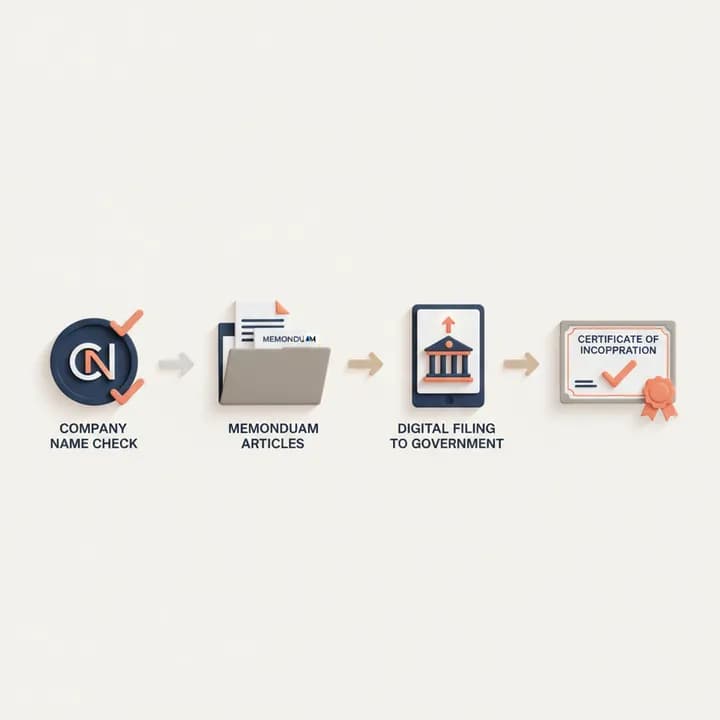
Your company name must be unique on the Companies House register and normally end with "Limited" or "Ltd". It cannot be the same as, or too similar to, an existing company name. Some words, such as "Bank", "Royal" or "Chartered", are sensitive and need supporting evidence or approval before you can use them. Offensive names and names that suggest a link with government are not allowed.
Check availability on the Companies House register before you commit, and also check that the matching domain and trade marks are free. A name that is short, easy to spell and relevant to what you do will serve you better than a clever one.
Registered office address and registered email
Every UK company needs a registered office address. It is where official letters from Companies House and HMRC are sent and it appears on the public register. It must be a physical address in the same part of the UK where the company is registered (England and Wales, Scotland or Northern Ireland), and it must be an "appropriate address", meaning documents sent there will come to someone's attention. A PO box is not accepted.
Many founders, particularly non-residents, use a registered office service so that their home address stays off the public record. Our article on registered business address vs service address explains the difference between the two addresses Companies House asks for.
Since March 2024, every company must also give Companies House a registered email address. It is not published, but Companies House uses it to contact the company.
Directors, shareholders and people with significant control
A UK private limited company needs at least one director and one shareholder, and they can be the same person. At least one director must be a natural person, and directors must be at least 16 years old. There is no residency or nationality requirement. Appointing a company secretary is optional for private companies.
Directors run the company and carry legal duties, such as acting within the company's powers and avoiding conflicts of interest. Our guide to the seven responsibilities of a corporate director covers them in plain language. Shareholders own the company, vote on key decisions and receive dividends.
You must also identify any person with significant control (PSC), typically anyone who holds more than 25% of the shares or voting rights or can otherwise control the company. Their details go on the PSC register.
Identity verification
Under the Economic Crime and Corporate Transparency Act, Companies House is introducing identity verification for directors and people with significant control. New directors and PSCs must verify their identity, either directly with Companies House through GOV.UK One Login or through an authorised corporate service provider. Build this step into your timeline.

The UK company formation process
Memorandum and articles of association
Two constitutional documents are filed with the application:
- Memorandum of association: a short statement signed by the first shareholders (subscribers) confirming they wish to form the company and become members.
- Articles of association: the company's rulebook, covering how directors are appointed, how decisions are made and how shares are transferred. Most small companies adopt the government's model articles, which can be amended later.
Registering with Companies House
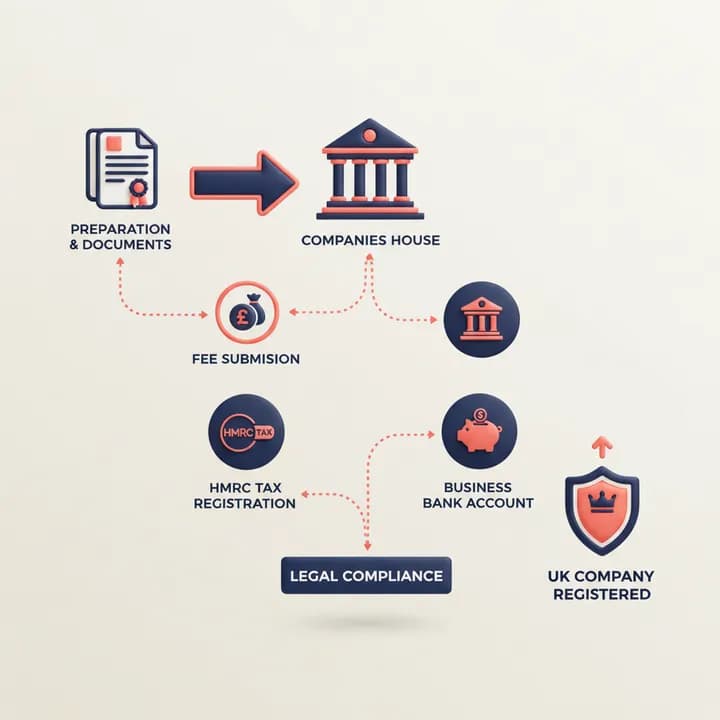
The application to register a company (form IN01, or the equivalent online service) includes:
- The company name and the part of the UK where the registered office is located.
- The registered office address and registered email address.
- Details of each director, including a correspondence (service) address and a usual residential address, which is kept off the public register.
- A statement of capital: the number, class and value of shares issued, and who holds them.
- Details of people with significant control.
- A SIC code describing the company's main business activity.
- A statement that the company is being formed for a lawful purpose.
- Payment of the Companies House fee.
The online incorporation fee rose to GBP 100 on 1 February 2026. Our article on UK incorporation fees and HMRC charges breaks down the current Companies House fees and confirms that HMRC charges nothing to register for tax. You can also check the official Companies House fee list.
Once approved, Companies House issues a Certificate of Incorporation showing the company registration number (CRN) and date of incorporation. Applications filed online are usually processed within 24 to 48 hours, provided the details are correct.
Additional considerations
- Licences and permits: some activities, such as financial services, food, alcohol or employment agencies, need a licence or registration before you trade.
- Business account: keep company money separate from personal funds from day one. Newly registered companies can apply for a business account; see our banking services and the practical tips in the difficulties of opening a bank account.
- Tax numbers: after registration, HMRC sends the company a Unique Taxpayer Reference. Our guide to tax numbers specific per country explains UTRs, VAT numbers and their equivalents elsewhere.

Post-registration obligations
Statutory requirements
- Confirmation statement: at least once every 12 months you confirm that the information Companies House holds is correct. You have 14 days after the review period ends to file it.
- Annual accounts: a new company's first accounts are due 21 months after incorporation. After that, accounts are due 9 months after the end of each financial year.
- Statutory registers: keep registers of members, directors and PSCs up to date, and report changes to Companies House.
- Company law: follow the Companies Act 2006 and your articles, including keeping records of decisions and board meetings.
Missing deadlines leads to automatic late filing penalties and, in serious cases, the company can be struck off the register.
Tax considerations
- Corporation Tax: register with HMRC within three months of starting to do business. The main rate is 25% on profits over GBP 250,000, a small profits rate of 19% applies to profits up to GBP 50,000, with marginal relief in between.
- VAT: UK-established businesses must register once taxable turnover exceeds GBP 90,000 in a rolling 12-month period. Non-UK established businesses selling taxable goods or services in the UK may need to register from the first sale.
- PAYE: if the company employs staff, including a paid director, it must register as an employer and run payroll.
Tax rules depend on your circumstances and where you live. This guide is general information, not tax advice, so speak to a qualified accountant about your own position.
Register your UK company with WeForm
WeForm's UK Standard package costs GBP 175 and covers the name check, incorporation documents, electronic filing with Companies House, the Certificate of Incorporation and company registration number, and a UK registered office for 12 months. The Companies House fee for setup is included, there are no hidden fees, and renewal is GBP 150 per year. The whole process runs online, including identity checks and electronic signing, and every package includes assistance with opening a payment account.
See the details on our UK company formation page or start your application.
FAQ
Can a non-resident register a company in the UK?
Yes. There is no requirement for directors or shareholders to live in the UK or be British. You do need a UK registered office address, which a formation provider can supply.
How long does it take to register a UK company?
Companies House usually registers an online application within 24 to 48 hours. Allow extra time for identity verification and for preparing your documents.
Do I need a company secretary?
No. Private limited companies are not required to appoint a company secretary, although they may choose to.
What is the minimum share capital?
There is no minimum. Many small companies start with one share of GBP 1 per shareholder, although you can issue more.
Is my home address made public?
Your usual residential address as a director is kept off the public register. The registered office and your service address are public, which is why many founders use a professional address.