LLC vs LTD vs Corporation: Key Differences for Entrepreneurs
How an LLC, a private limited company (LTD) and a corporation differ in ownership, liability, tax and management, and how to choose the right one.
 6 min read
Choosing a legal structure is one of the first decisions you make when starting a business, and it affects tax, liability, paperwork and how easily you can bring in investors. Three terms come up again and again: LLC, LTD and corporation. They are often used as if they were interchangeable, but they come from different legal systems and work differently.
This guide explains the difference between an LLC and an LTD, compares a limited company with a corporation, and helps you work out which fits your plans.
What are LLCs, LTDs and corporations?
LLC (limited liability company)
The LLC is a US business entity formed under state law. Owners are called members. It combines limited liability with flexible management and tax treatment: by default, an LLC with one member is disregarded for US federal income tax and one with several members is taxed as a partnership, so profits pass through to the owners. An LLC can elect to be taxed as a corporation instead. Several other countries have similar entities. In Costa Rica, for example, the Sociedad de Responsabilidad Limitada (SRL) is a limited liability company with quotas instead of shares.
LTD (private limited company)
The private company limited by shares, marked "Ltd" or "Limited", is the standard small business company in the UK and many Commonwealth and common-law jurisdictions, including Hong Kong. Owners are shareholders, the company is run by directors, and the company itself pays corporation tax on its profits. Shares cannot be offered to the public.
Corporation (Inc. or Corp.)
A corporation is a separate legal entity owned by shareholders and managed by a board of directors and officers. In the US, a C corporation pays corporate income tax, and dividends are taxed again in shareholders' hands. An S corporation passes profits through to shareholders but is restricted to a limited number of eligible, generally US, shareholders. Corporations outside the US, such as a Marshall Islands non-resident domestic corporation, follow similar corporate law principles; Marshall Islands law is modelled on Delaware's.
Key differences: LLC vs LTD vs corporation
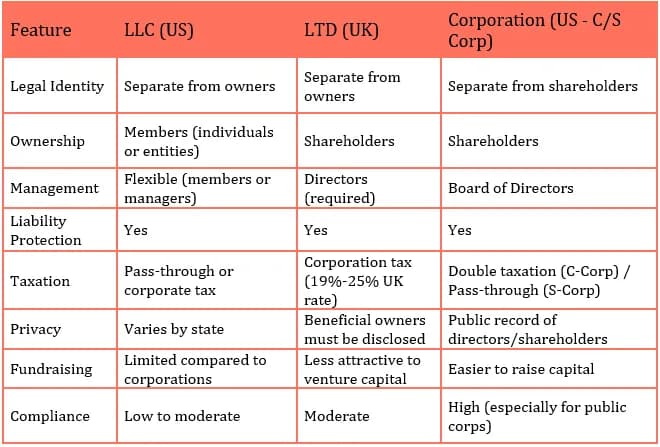
Ownership
- LLC: members holding membership interests, set out in an operating agreement.
- LTD: shareholders holding shares, governed by the articles of association.
- Corporation: shareholders holding stock, governed by articles (or a certificate) of incorporation and bylaws.
Liability
- All three give owners limited liability, so personal assets are generally protected from company debts. Directors and managers can still be personally liable for wrongdoing, such as fraud or trading while insolvent.
Taxation
- LLC: pass-through by default in the US, with the option to be taxed as a corporation.
- LTD: taxed as a company. In the UK, corporation tax is 19% on profits up to GBP 50,000 and 25% above GBP 250,000, with marginal relief in between. Hong Kong taxes only profits sourced in Hong Kong.
- Corporation: taxed as a company, with possible second taxation on dividends. Offshore corporations, such as those in the Marshall Islands, pay no local tax on non-resident income, but owners may be taxed where they live.
Management and formality
- LLC: flexible; can be managed by its members or by appointed managers, with few mandatory formalities.
- LTD: run by directors, with statutory filings such as annual accounts and a confirmation statement in the UK.
- Corporation: the most formal; board resolutions, officers, shareholder meetings and bylaws.
Raising investment
- LLC: workable for small groups of investors, but many venture investors prefer corporations.
- LTD: issuing new shares and share classes is straightforward, and UK investors know the structure well.
- Corporation: the standard vehicle for venture capital and, eventually, public listing.
Jurisdiction matters: UK LTD vs US LLC
Both offer limited liability and a credible structure, but they suit different situations.
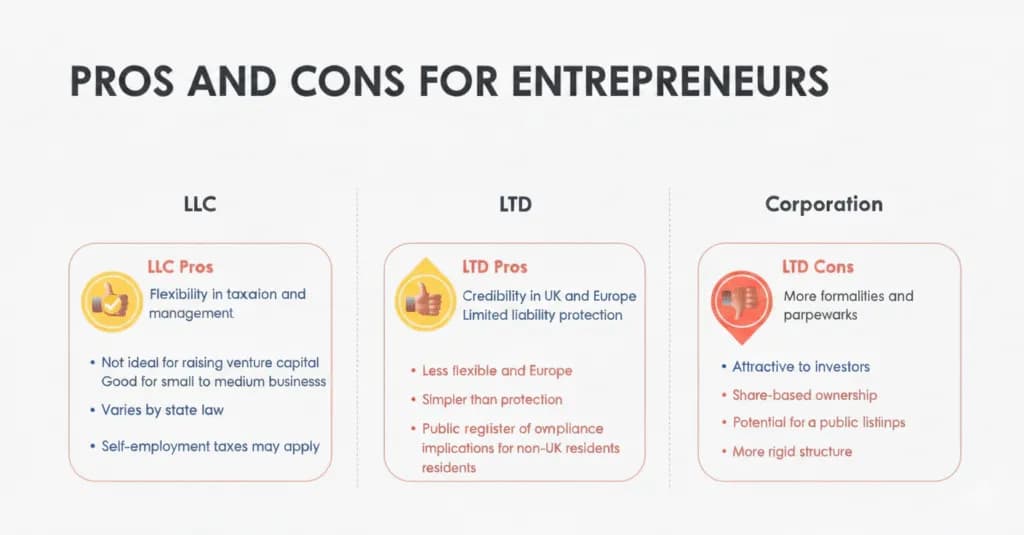
UK LTD pros
- Recognised internationally and trusted by banks and payment providers.
- Fast, fully online registration, usually within 24 to 48 hours.
- No residency requirement for directors or shareholders.
- Simple share structure that suits investors.
US LLC pros
- Flexible tax classification.
- Few internal formalities.
- Flexible ownership and profit-sharing arrangements.
For non-US founders, a US LLC brings its own reporting duties; for example, a foreign-owned single-member LLC must still file an annual information return with the IRS. Consider where your customers, partners and investors are based, and where you personally pay tax, before deciding.
How to choose the right legal structure
Ask yourself:
- Where will the business operate and where are your customers?
- Where do you, as the owner, pay tax?
- Do you plan to raise outside investment?
- Do you prefer flexibility or a formal governance structure?
- Which banks and payment providers will you need?
Quick guidance
- Choose an LTD if you want an internationally trusted company with straightforward shares and limited liability, for example a UK limited company or a Hong Kong company.
- Choose an LLC-style entity if you value flexible ownership and fewer formalities. A Costa Rica SRL offers limited liability, territorial taxation and 100% foreign ownership.
- Choose a corporation if you want a classic share company with board governance. A Marshall Islands corporation offers Delaware-modelled law, private ownership records and zero tax on non-resident income.
For more background, read company structure types and their benefits, sole proprietorship vs limited liability company and our list of the best places to incorporate a company.
How WeForm can help
WeForm forms companies online in six jurisdictions: the United Kingdom (from GBP 175), Hong Kong (from USD 1,250), Seychelles (from USD 550), the Marshall Islands (from USD 900), Costa Rica (from USD 2,200) and IFZA Dubai (priced in the application). Every package includes the setup government fees, registered office for the first year and assistance with opening a payment account through our banking services. We do not form US LLCs or corporations. Compare the options on our jurisdictions page or start your application.
FAQ
Is an LTD the same as an LLC?
No. Both limit owners' liability, but an LLC is a US-style entity with flexible, usually pass-through, taxation, while an LTD is a company limited by shares that pays corporation tax itself.
Is a limited company a corporation?
In a broad legal sense, yes: a limited company is a body corporate with its own legal personality. In everyday use, "corporation" usually refers to US-style corporations with boards, officers and stock.
Which structure is best for a small business?
It depends on where you operate and pay tax. Many small international businesses choose a private limited company for its credibility and simplicity. Take tax advice in your country of residence before deciding.
Can a non-resident own a UK LTD?
Yes. There are no residency or nationality requirements for directors or shareholders of a UK private limited company. See our guide to registering a company in the UK.
This article is general information, not legal or tax advice.