Company Structure Types and Their Benefits
Organisational structures and legal entity types compared: sole trader, partnership, LLP, limited company, IBC and trust, with the benefits and drawbacks of each.
 7 min read
"Company structure" can mean two things. The first is the organisational structure: how work, authority and communication are arranged inside a business. The second is the legal structure: the type of entity the business operates through, such as a sole trader, a partnership or a limited company. Both affect how well a business runs, and the legal choice also decides your liability, tax and paperwork. This guide covers both, starting with the organisational side.
What is an organisational structure?
An organisational structure sets out how tasks are divided, who reports to whom and who makes which decisions. In a two-person start-up it may be informal. As the company grows, a clear structure becomes the difference between a team that moves fast and one that keeps stepping on its own toes.
Common types of organisational structure
- Functional: teams grouped by function, such as sales, finance, product and operations. Simple and efficient for small and mid-sized companies.
- Divisional: separate units by product, market or region, each with its own functions. Suits companies operating in several countries.
- Matrix: people report to both a functional manager and a project or product lead. Flexible, but needs clear rules to avoid confusion.
- Flat: few management layers and broad responsibilities. Common in start-ups and remote teams.
Benefits of a clear organisational structure
- Faster decision-making. When everyone knows who decides what, decisions do not wait for the founder.
- Consistency across locations. If you run several sites or teams in different countries, a defined structure keeps policies and standards the same everywhere.
- Higher productivity. People who know their responsibilities work faster and with fewer handovers.
- Better employee performance. Clear roles, resources and reporting lines help people do their best work and build confidence.
- No duplicated work. Teams with defined areas do not end up doing the same task twice.
- Fewer conflicts. Clear responsibilities reduce friction over who owns what.
- More effective communication. People know whom to ask and whom to inform.
Legal company structure types
The legal structure is the decision you make when you register the business. The examples below use UK terminology, which is widely used internationally; other countries have close equivalents. For a deeper comparison of the two most common choices, read sole proprietorship vs limited liability company and LLC vs LTD vs corporation.
Sole trader (self-employed)
The simplest structure: you and the business are legally the same person. In the UK you register with HMRC for Self Assessment and pay income tax on your profits at your personal rates (in England, Wales and Northern Ireland 20%, 40% above GBP 50,270 and 45% above GBP 125,140 of income in 2026/27), plus National Insurance. You can still employ staff, but you must register as an employer and follow employment law.
Advantages: free and quick to set up, minimal administration, full control, and you keep all profits after tax.
Disadvantages: unlimited personal liability. Your house, savings and other assets can be used to pay business debts or claims. Some clients and payment providers also prefer to contract with companies, and business and personal finances are harder to separate.
General partnership
Two or more people running a business together to make a profit. A partnership can be formed with little formality, though a written partnership agreement is strongly advised. Each partner pays tax on their share of the profits, and partners are usually jointly liable for the partnership's debts without limit.
Limited liability partnership (LLP)
An LLP combines the flexibility of a partnership with limited liability. It is popular with law firms, accountancy practices and other professional services, where partners pool offices, staff and clients but do not want to be personally liable for another partner's mistakes.
- Members can be added or removed under the terms of the LLP agreement, which suits firms that promote senior staff to partner.
- An LLP is usually tax transparent: profits are taxed in the hands of the members, not the LLP.
- It must be registered and file accounts, much like a company.
Private limited company (Ltd)
A private limited company is a separate legal entity from its owners. "Ltd" or "Limited" after the name shows that shareholders' liability is limited to the amount unpaid on their shares. If the company fails, shareholders lose what they invested but their personal assets are protected.
A private company can have one or more shareholders and at least one director, who does not need to own shares. The company owns its profits and pays corporation tax on them; in the UK the rate is 19% for profits up to GBP 50,000 and 25% above GBP 250,000, with marginal relief in between. Owners take money out as salary, dividends or repayment of loans, and company money must be kept separate from personal money. See the responsibilities of a corporate director before you take the role.
Advantages: limited liability, a professional image with clients and banks, flexible ownership through shares, and often a lower tax rate on retained profits than personal income tax.
Disadvantages: more administration (annual accounts, confirmation statement, statutory registers), public disclosure of certain information, and shares cannot be offered to the public. Limited liability also has limits: directors who personally guarantee a loan are liable under that guarantee, and directors can be held personally liable for wrongful trading if they keep trading when insolvency is unavoidable.
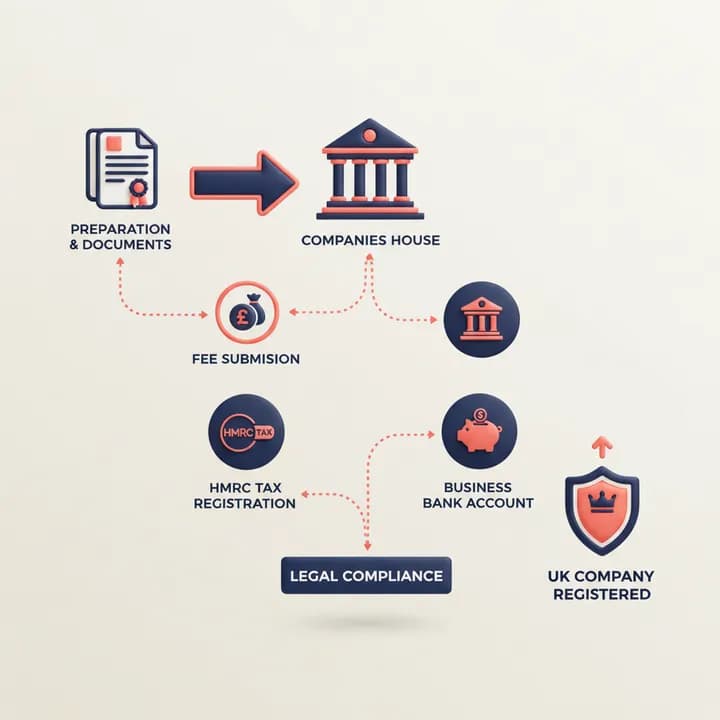
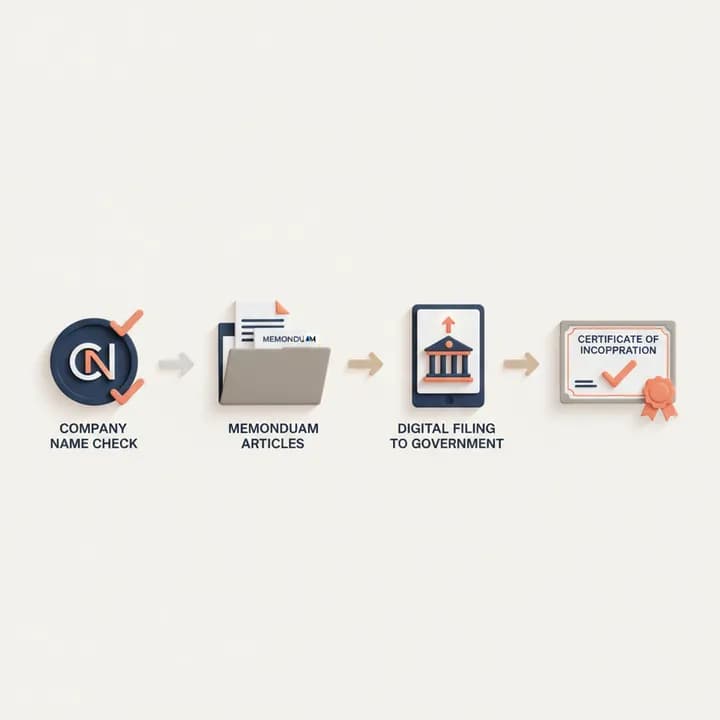
WeForm registers UK private limited companies from GBP 175, including the Companies House filing and a UK registered office for 12 months.
International business company and corporation
Many jurisdictions offer a company form designed for international business. A Seychelles IBC or a Marshall Islands corporation works like a limited company: separate legal personality, shareholders with limited liability and at least one director. They are often used for international trading, consulting and holding structures. Read what an offshore company is and the best country for a holding company to see where they fit.
Trust
A trust is not a company but a legal relationship. A settlor transfers assets to trustees, who hold and manage them for the benefit of beneficiaries according to the trust deed. Trusts are mainly used for estate planning, family wealth and asset protection.
- Living or testamentary: a living trust is set up during the settlor's lifetime; a testamentary trust is created by a will and takes effect on death.
- Revocable or irrevocable: a revocable trust can be changed or cancelled by the settlor; an irrevocable trust cannot. Because assets in an irrevocable trust have left the settlor's control, it is the type more often used for estate tax planning.
Trusts are governed by the law of the country where they are set up, need careful drafting and are usually arranged with a lawyer.
How to choose the right legal structure
- Liability: if the business takes on debts, contracts or risk, a limited company or LLP protects your personal assets.
- Tax: compare personal income tax as a sole trader with corporation tax plus dividend tax as a company owner. Your accountant can model both.
- Growth and investment: investors buy shares, so a company is the natural structure if you plan to raise money.
- Clients and banks: many corporate clients and payment providers prefer to work with companies. A company also makes it easier to open dedicated payment accounts.
- Location: where you and your clients are decides which country's structure makes sense. Compare options on all jurisdictions.
Once you have decided, our guide to the first steps with a new company covers what comes next, or you can start your application online.
FAQ
What are the main types of company structure?
Legally: sole trader, partnership, limited liability partnership, private limited company and, for international business, IBCs and corporations. Organisationally: functional, divisional, matrix and flat structures.
Which structure gives limited liability?
Private limited companies, IBCs, corporations and LLPs. Sole traders and general partners have unlimited personal liability.
Can one person form a limited company?
Yes. In the UK, Hong Kong, Seychelles and the Marshall Islands, for example, one person can be both the sole shareholder and the director. A Hong Kong company also needs a company secretary, which WeForm provides in the package.