What's the Best Payment Solution for Your Business?
Cards, wallets, bank transfers or local methods? How to compare payment solutions on total cost, security and fit, and pick the right one for your business.
 5 min read
Accepting payments used to mean cash, cheques and a card terminal from your bank. Today customers expect to pay by card, digital wallet, bank transfer, instant account-to-account payment or a local method popular in their country, online and in person. More choice for customers means more decisions for the business. There is no single best payment solution; there is the one that fits where your customers are, how they buy and what it costs you in total.
Payment methods your customers expect
- Debit and credit cards. Still the default for most online and in-store purchases worldwide.
- Digital wallets. Apple Pay, Google Pay and similar wallets store the card on the phone and speed up checkout.
- Bank transfers and open banking. Account-to-account payments, including instant schemes such as SEPA Instant in Europe and Faster Payments in the UK, are cheaper than cards for larger amounts.
- Local payment methods. In many markets a local scheme or wallet is the preferred way to pay. Selling abroad often means supporting them.
- Buy now, pay later. Popular for retail baskets, usually at a higher merchant fee.
- Invoices and recurring billing. B2B and subscription businesses need invoicing, direct debits or stored card payments.
For a wider view of where this is going, see electronic payment trends for global entrepreneurs.
The main types of payment solution
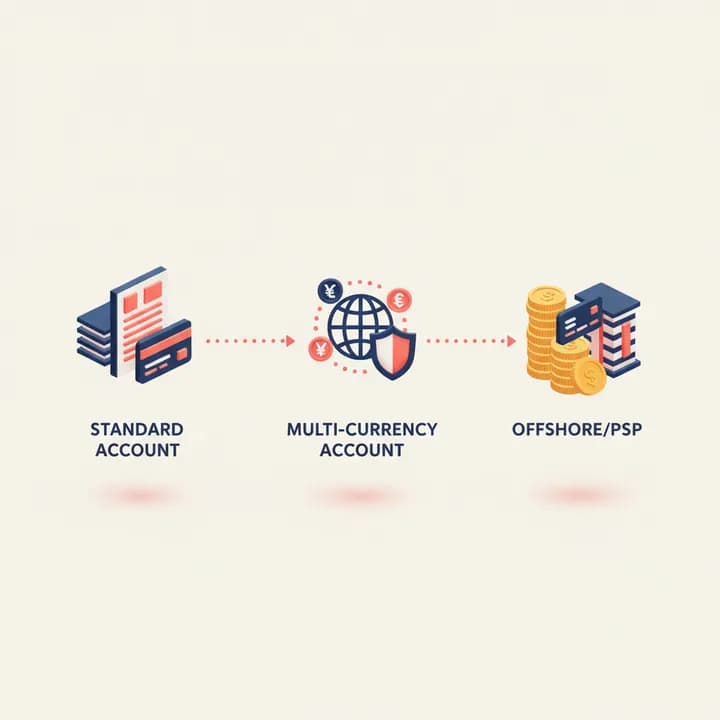
Merchant account with an acquirer
A dedicated merchant account from an acquiring bank or processor. It gives more control and often lower rates at volume, but onboarding is stricter and may require trading history.
Payment service provider (PSP) or aggregator
A PSP bundles acquiring, a payment gateway and many payment methods under one contract. Setup is fast and suits new and small businesses. The trade-off is less flexibility on pricing and the risk that the provider holds funds if it sees unusual activity.
Point-of-sale systems
Physical shops need a terminal or a mobile reader linked to a tablet or phone. If you sell both in store and online, choose a system that combines both channels so that sales, refunds and stock live in one place.
Business and multi-currency accounts
Payments have to settle somewhere. A multi-currency business account lets you receive, hold and pay in several currencies without converting every transaction.
What payments really cost
Many businesses only notice processing costs when they see the monthly statement. Compare offers on the total cost of ownership:
- Per-transaction fees. Blended pricing charges one rate for everything; interchange-plus-plus pricing passes through the card scheme costs plus a fixed margin and is usually more transparent.
- Card mix. Premium, commercial and non-domestic cards cost more to accept than domestic consumer debit cards.
- Card-not-present transactions. Online payments usually carry higher fees and fraud risk than in-person chip payments.
- Currency conversion. The markup on foreign exchange can cost more than the processing fee itself.
- Hardware. A "free" terminal may come with higher rates or a long contract. Leasing can cost more over time than buying.
- Other charges. Monthly minimums, chargeback fees, payout fees, rolling reserves and early termination fees.
Also check whether you can pass costs on. In the UK and the EU, surcharging consumers for paying by standard consumer cards is not allowed, so card fees are a cost of doing business.
Security and compliance
- PCI DSS. Any business that handles card data must follow the Payment Card Industry Data Security Standard. Using a hosted checkout from your PSP reduces the part of the standard you are responsible for.
- Strong customer authentication. In the UK and the EEA, most online card payments need two-factor authentication such as 3-D Secure. Check that your checkout handles it without losing sales.
- Fraud and chargebacks. Ask what fraud screening is included and how disputes are handled. High chargeback rates can lead to account closure.
- Onboarding checks. Providers will verify your company, directors and owners and ask about your products, website, refund policy and expected volumes.
How to choose the best payment solution for your business
- Start with your customers. Where are they, which currencies do they use and how do they prefer to pay?
- Map your channels. Online only, in store, or both. Online-only businesses do not need terminals; mixed businesses need one system for both.
- Estimate volumes. Average ticket size and monthly turnover decide whether flat or interchange-plus pricing is cheaper.
- Compare total cost. Put per-transaction fees, FX markups, hardware and fixed fees side by side for the length of the contract.
- Check settlement. How fast are payouts, in which currencies, and to which accounts?
- Think ahead. Choose a provider that lets you add new methods and markets without switching platforms.
- Prepare your company documents. Providers onboard companies, not ideas. A registered company with clear ownership and a working website gets approved faster.
If you are still deciding between a bank and a fintech provider, read traditional banking v digital payment solution providers. Online sellers should also check what most e-commerce businesses miss when starting out.
How WeForm helps
WeForm forms companies online in the United Kingdom, Hong Kong, Seychelles, the Marshall Islands, Costa Rica and the IFZA free zone in Dubai. Every package includes payment account opening assistance: we introduce your company to supported banks, EMIs and payment service providers offering multi-currency accounts, processing and collections. Approval is the institution's decision, and account opening typically takes 3-14 business days, fully remotely. See our payment solutions and banking services, or start your company. If you have not formed your company yet, our guide to the first steps with a new company is a good place to begin.
FAQ
What is the best payment solution for a small business?
For most new online businesses, a payment service provider with a hosted checkout is the fastest start. As volumes grow, a dedicated merchant account or interchange-plus pricing can lower costs.
Do I need a merchant account to accept cards?
Not always. Aggregators let you accept cards under their own merchant setup. Higher-volume or specialised businesses often move to a dedicated merchant account.
Can a newly incorporated company get a payment account?
Yes. Many EMIs and PSPs onboard new companies if ownership, business model and website are clear.
Which payment methods should I offer?
At minimum, cards and the main digital wallets. Add bank transfers and local methods for the markets where your customers are.