Electronic Payment Trends in the Digital Nomad Era
The payment solutions and 2026 trends that matter for location-independent businesses, and a step-by-step guide to choosing a fast, low-cost payment set-up.
 7 min read
For digital nomads and founders who run their companies across borders, payments are part of the core infrastructure of the business. How quickly you get paid, how much you lose on currency conversion and how easily clients can pay you all affect cash flow and margins. This guide covers the main types of electronic payment solutions, the trends shaping them in 2026, and how to choose the right set-up for a location-independent business.
Why modern payment systems matter for global businesses
Relying only on international bank wires is slow and expensive: transfers can take days and lose value to intermediary bank charges and wide exchange rate margins. Whether you invoice clients on another continent, pay contractors abroad or run a subscription business, you need payments that are fast, predictable and cheap. The right payment set-up also makes compliance easier, because company income and expenses flow through accounts in the company's name.
The main types of electronic payment solutions
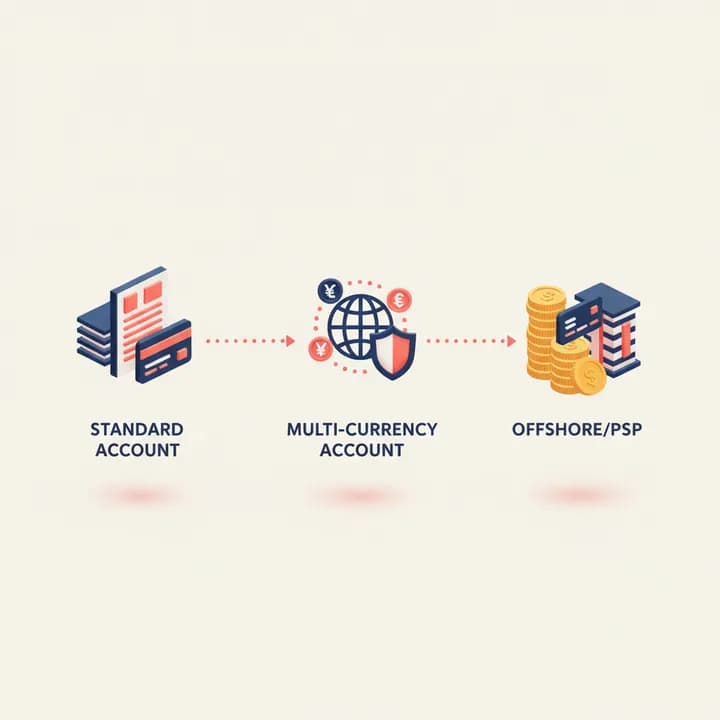
- Multi-currency business accounts: accounts with banks or electronic money institutions (EMIs) that let you hold, receive and pay in several currencies, often with local account details in different countries.
- Digital wallets: apps and wallets that store payment credentials and enable fast, contactless payments online and in person.
- Payment gateways and merchant services: services that let your website or app accept cards and local payment methods, encrypt the data and pass it on for authorisation.
- Account-to-account and instant payments: direct transfers between bank accounts over instant payment schemes or open banking, increasingly used for invoices and checkout.
- Peer-to-peer platforms: apps for sending money between individuals, sometimes used by freelancers, though usually less suited to business record-keeping.
How the main options compare
- Multi-currency account: best for international invoicing, paying suppliers and holding several currencies. Cross-border costs are usually lower and FX rates more transparent than at a traditional bank. Good integrations with accounting and e-commerce tools.
- Traditional bank account: best for domestic business, lending and counterparties that insist on a bank. International wires can take several business days and may involve intermediary fees.
- Payment gateway or PSP: essential if you sell online and need to accept cards, wallets and local methods. Settlement goes to your business account.
- P2P app: quick for small transfers, but limited for business use and often not intended for commercial activity.
For a deeper comparison, read what's the best payment solution for your business.
Electronic payment trends to watch in 2026
1. Instant payments become the default
Instant payment schemes are now widespread. In the euro area, the EU Instant Payments Regulation requires payment providers to offer instant euro transfers at no higher price than standard transfers, together with a check that the payee's name matches the account. Similar systems run in many other markets. For businesses, this means faster settlement and fewer misdirected payments.
2. Faster, cheaper cross-border payments
Cross-border payments are still slower and costlier than domestic ones, and improving them is an explicit goal of the G20 roadmap coordinated by the Financial Stability Board and the BIS Committee on Payments and Market Infrastructures. Richer payment data under the ISO 20022 messaging standard and links between domestic instant systems are part of that effort.
3. Pay by bank and open banking
Open banking lets customers pay directly from their bank account at checkout, often with lower fees than cards. It is growing fastest in markets with strong open banking rules, such as the UK and EU.
4. Embedded finance
Payments, invoicing, cards and even lending are increasingly built into the software businesses already use, such as accounting, e-commerce and marketplace platforms. Fewer separate tools mean less manual reconciliation.
5. Stronger security and authentication
Biometrics, tokenisation and strong customer authentication are now standard, and providers are investing heavily in fraud detection as scams grow more sophisticated. Read more in safeguarding your finances with digital banking.
6. Central bank digital currencies and digital assets
Many central banks are researching or piloting digital currencies, and regulation of stablecoins and crypto-assets is developing in several regions. These are worth watching, but for most businesses they are not yet a replacement for regulated accounts and card acceptance.
The Bank for International Settlements has published research on how fintech affects payments and financial inclusion. For the wider banking picture, see our article on digital banking trends for 2026 and beyond.
How to choose the right payment solution: step by step
Step 1: Map your money flows
Who pays you, who do you pay, in which currencies and how often? Your answers show whether you mainly need international invoicing, card acceptance, mass payouts or a mix.
Step 2: Check coverage
Make sure the provider supports the countries and currencies of your clients and suppliers, and accepts companies from your jurisdiction of incorporation. Not every provider works with every jurisdiction.
Step 3: Compare the full cost
Look beyond the headline fee. Include monthly charges, transfer fees, FX markups, chargeback fees and withdrawal costs. A slightly higher transaction fee can be cheaper overall if the exchange rate is better.
Step 4: Verify regulation and security
Choose licensed, supervised providers. Card processing should meet PCI DSS standards, and your account should support two-factor authentication. Expect KYC checks: identity documents and proof of address for directors and beneficial owners, plus your company's certificate of incorporation and other corporate documents.
Step 5: Plan for integration and growth
Check that the solution connects to your accounting software and sales channels, supports batch payments and multiple users, and can handle higher volumes as you grow.
Key features for digital nomads and international founders
- Local account details in several currencies: clients pay you like a local business, avoiding international wire fees.
- Competitive, transparent FX: hold balances in several currencies and convert when it suits you.
- Batch payments: pay many contractors or suppliers with one file upload.
- Remote onboarding and app access: open and run the account from anywhere.
- Strong security: two-factor authentication, card controls and real-time alerts.
Our guide to opening a multi-currency business account explains the application process in detail.
Common pitfalls to avoid
- Ignoring hidden costs: FX markups and monthly fees add up quickly.
- Using personal accounts for business: mixing funds complicates accounting and can undermine the separation between you and your company.
- Choosing a solution you will outgrow: a tool built for a solo freelancer may not handle a team, higher volumes or multiple entities.
- Overlooking local preferences: customers in different regions prefer different payment methods; offer the ones your market trusts.
- Undeclared activity: describe your business accurately when you apply. Activity that does not match your profile is a common reason for accounts being restricted.
Glossary of payment terms
- IBAN: International Bank Account Number, a standard format for identifying bank accounts across borders.
- FX: foreign exchange, converting one currency into another.
- EMI: electronic money institution, a regulated firm that issues e-money and provides accounts and payments.
- PSP: payment service provider, a company that lets merchants accept electronic payments.
- PCI DSS: the Payment Card Industry Data Security Standard for businesses that handle card data.
- Payment gateway: the technology that captures payment details and sends them for authorisation.
- Open banking: regulated access, with the customer's consent, to bank accounts for payments and data.
Building your payment set-up with WeForm
The right payment set-up starts with the right company. WeForm forms companies online in six jurisdictions, from a UK private limited company to a Seychelles IBC or an IFZA Dubai free zone company. If you are still deciding where to base your business, read our guide to the best countries to incorporate for digital nomads.
Every package includes payment account opening assistance. We introduce your company to supported banks, EMIs and PSPs offering multi-currency accounts, payment processing and collections. Account opening is fully remote and typically takes 3-14 business days, and approval is always the institution's decision. See our banking services and payment solutions, or start your company today.
FAQ
What is the best electronic payment solution for a freelancer?
For most freelancers working with international clients, a multi-currency business account with local account details in the main currencies they invoice is the most practical choice, combined with a payment link or gateway if clients pay by card.
How can I accept card payments on my website?
You need a payment gateway and merchant account, or a PSP that combines both. It connects to your website or e-commerce platform and settles funds to your business account.
Can I hold multiple currencies in one account?
Yes. Multi-currency accounts let you hold balances in currencies such as USD, EUR and GBP and convert between them when you choose.
What is the difference between a payment gateway and a payment processor?
The gateway captures and encrypts the customer's payment details; the processor communicates with card networks and banks to complete the transaction. Many providers offer both in one service.
Can a newly formed company get a business account?
Yes. Many banks, EMIs and PSPs accept newly incorporated companies, provided the company documents and business information meet their compliance checks.